
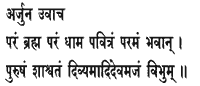
Arjuna said: Thou art the supreme Brahman, the supreme Abode, the supreme Purity, the one permanent, the divine Purusha, the original Godhead, the Unborn, the all-pervading Lord.
Man and the Battle of Life
Sri Aurobindo
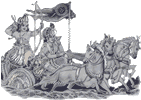
THUS, if we are to appreciate in its catholicity the teaching of the Gita, we must accept intellectually its standpoint and courageous envisaging of the manifest nature and process of the world. The divine charioteer of Kurukshetra reveals himself on one side as the Lord of all the worlds and the Friend and omniscient Guide of all creatures, on the other as Time the Destroyer “arisen for the destruction of these peoples.” The Gita, following in this the spirit of the catholic Hindu religion, affirms this also as God; it does not attempt to evade the enigma of the world by escaping from it through a side-door. If, in fact, we do not regard existence merely as the mechanic action of a brute and indifferentmaterial Force or, on the other hand, as an equally mechanical play of ideas and energies arising out of an original Non-Existence or else reflected in the passive Soul or the evolution of a dream or nightmare in the surface consciousness of an indifferent, immutable Transcendence which is unaffected by the dream and has no real part in it,—if we accept at all, as the Gita accepts, the existence of God, that is to say of the omnipresent, omniscient, omnipotent, yet always transcendent Being who manifests the world and Himself in the world, who is not the slave but the lord of His creative Consciousness, Nature or Force (Maya, Prakriti or Shakti), who is not baffled or thwarted in His world-conception or design by His creatures, man or devil, who does not need to justify Himself by shifting the responsibility for any part of His creation or manifestation on that which is created or manifested, then the human being has to start from a great, a difficult act of faith. Finding himself in a world which is apparently a chaos of battling powers, a clash of vast and obscure forces, a life which subsists only by constant change and death, menaced from every side by pain, suffering, evil and destruction, he has to see the omnipresent Deity in it all and conscious that of this enigma there must be a solution and beyond this Ignorance in which he dwells a Knowledge that reconciles, he has to take his stand upon this faith, “Though Thou slay me, yet will I trust in Thee.” All human thought or faith that is active and affirmative, whether it be theistic, pantheistic or atheistic, does in fact involve more or less explicitly and completely such an attitude. It admits and it believes: admits the discords of the world, believes in some highest principle of God, universal Being or Nature which shall enable us to transcend, overcome or harmonise these discords, perhaps even to do all three at once, to harmonise by overcoming and transcending. Then, as to human life in its actualities, we have to accept its aspect of a struggle and a battle mounting into supreme crises such as that of Kurukshetra. The Gita, as we have seen, takes for its frame such a period of transition and crisis as humanity periodically experiences in its history, in which great forces clash together for a huge destruction and reconstruction, intellectual, social, moral, religious, political, and these in the actual psychological and social stage of human evolution culminate usually through a violent physical convulsion of strife, war or revolution. The Gita proceeds from the acceptance of the necessity in Nature for such vehement crises and it accepts not only the moral aspect, the struggle between righteousness and unrighteousness, between the self-affirming law of Good and the forces that oppose its progression, but also the physical aspect, the actual armed war or other vehement physical strife between the human beings who represent the antagonistic powers. We must remember that the Gita was composed at a time when war was even more than it is now a necessary part of human activity and the idea of its elimination from the scheme of life would have been an absolute chimera. The gospel of universal peace and goodwill among men—for without a universal and entire mutual goodwill there can be no real and abiding peace— has never succeeded for a moment in possessing itself of human life during the historic cycle of our progress, because morally, socially, spiritually the race was not prepared and the poise of Nature in its evolution would not admit of its being immediately prepared for any such transcendence. Even now we have not actually progressed beyond the feasibility of a system of accommodation between conflicting interests which may minimise the recurrence of the worst forms of strife. And towards this consummation the method, the approach which humanity has been forced by its own nature to adopt, is a monstrous mutual massacre unparalleled in history; a universal war, full of bitterness and irreconcilable hatred, is the straight way and the triumphant means modern man has found for the establishment of universal peace! That consummation, too, founded not upon any fundamental change in human nature, but upon intellectual notions, economic convenience, vital and sentimental shrinkings from the loss of life, discomfort and horror of war, effected by nothing better than political adjustments, gives no very certain promise of firm foundation and long duration. A day may come, must surely come, we will say, when humanity will be ready spiritually, morally, socially for the reign of universal peace; meanwhile the aspect of battle and the nature and function of man as a fighter have to be accepted and accounted for by any practical philosophy and religion. The Gita, taking life as it is and not only as it may be in some distant future, puts the question how this aspect and function of life, which is really an aspect and function of human activity in general, can be harmonised with the spiritual existence. The Gita is therefore addressed to a fighter, a man of action, one whose duty in life is that of war and protection, war as a part of government for the protection of those who are excused from that duty, debarred from protecting themselves and therefore at the mercy of the strong and the violent, war, secondly and by a moral extension of this idea, for the protection of the weak and the oppressed and for the maintenance of right and justice in the world. For all these ideas, the social and practical, the moral and the chivalrous enter into the Indian conception of the Kshatriya, the man who is a warrior and ruler by function and a knight and king in his nature. Although the more general and universal ideas of the Gita are those which are the most important to us, we ought not to leave out of consideration altogether the colouring and trend they take from the peculiar Indian culture and social system in the midst of which they arose. That system differed from the modern in its conception. To the modern mind man is a thinker, worker or producer and a fighter all in one, and the tendency of the social system is to lump all these activities and to demand from each individual his contribution to the intellectual, economical and military life and needs of the community without paying any heed to the demands of his individual nature and temperament. The ancient Indian civilisation laid peculiar stress on the individual nature, tendency, temperament and sought to determine by it the ethical type, function and place in the society. Nor did it consider man primarily as a social being or the fullness of his social existence as the highest ideal, but rather as a spiritual being in process of formation and development and his social life, ethical law, play of temperament and exercise of function as means and stages of spiritual formation. Thought and knowledge, war and government, production and distribution, labour and service were carefully differentiated functions of society, each assigned to those who were naturally called to it and providing the right means by which they could individually proceed towards their spiritual development and self-perfection. The modern idea of a common obligation in all the main departments of human activity has its advantages; it helps to greater solidarity, unity and fullness in the life of the community and a more all-round development of the complete human being as opposed to the endless divisions and over-specialisation and the narrowing and artificial shackling of the life of the individual to which the Indian system eventually led. But it has also its disadvantages and in certain of its developments the too logical application of it has led to grotesque and disastrous absurdities. This is evident enough in the character of modern war. From the idea of a common military obligation binding on every individual to defend and fight for the community by which he lives and profits, has arisen the system by which the whole manhood of the nation is hurled into the bloody trench to slay and be slain, thinkers, artists, philosophers, priests, merchants, artisans all torn from their natural functions, the whole life of the community disorganised, reason and conscience overridden, even theminister of religion who is salaried by the State or called by his function to preach the gospel of peace and love forced to deny his creed and become a butcher of his fellow-men! Not only are conscience and nature violated by the arbitrary fiat of the military State, but national defence carried to an insane extreme makes its best attempt to become a national suicide. Indian civilisation on the contrary made it its chief aim to minimise the incidence and disaster of war. For this purpose it limited the military obligation to the small class who by their birth, nature and traditions were marked out for this function and found in it their natural means of self-development through the flowering of the soul in the qualities of courage, disciplined force, strong helpfulness and chivalrous nobility for which the warrior’s life pursued under the stress of a high ideal gives a field and opportunities. The rest of the community was in every way guarded from slaughter and outrage; their life and occupations were as little interfered with as possible and the combative and destructive tendencies of human nature were given a restricted field, confined in a sort of lists so as to do the minimum amount of harm to the general life of the race, while at the same time by being subjected to high ethical ideals and every possible rule of humanity and chivalry the function of war was obliged to help in ennobling and elevating instead of brutalising those who performed it. It must be remembered that it is war of this kind and under these conditions that the Gita had in view, war considered as an inevitable part of human life, but so restricted and regulated as to serve like other activities the ethical and spiritual development which was then regarded as the whole real object of life, war destructive within certain carefully fixed limits of the bodily life of individual men but constructive of their inner life and of the ethical elevation of the race. That war in the past has, when subjected to an ideal, helped in this elevation, as in the development of knighthood and chivalry, the Indian ideal of the Kshatriya, the Japanese ideal of the Samurai, can only be denied by the fanatics of pacifism. When it has fulfilled its function, it may well disappear; for if it tries to survive its utility, it will appear as an unrelieved brutality of violence stripped of its ideal and constructive aspects and will be rejected by the progressive mind of humanity; but its past service to the race must be admitted in any reasonable view of our evolution. The physical fact of war, however, is only a special and outward manifestation of a general principle in life and the Kshatriya is only the outward manifestation and type of a general characteristic necessary to the completeness of human perfection. War typifies and embodies physically the aspect of battle and struggle which belongs to all life, both to our inner and our outer living, in a world whose method is a meeting and wrestling of forces which progress by mutual destruction towards a continually changing adjustment expressive of a progressive harmonising and hopeful of a perfect harmony based upon some yet ungrasped potentiality of oneness. The Kshatriya is the type and embodiment of the fighter in man who accepts this principle in life and faces it as a warrior striving towards mastery, not shrinking from the destruction of bodies and forms, but through it all aiming at the realisation of some principle of right, justice, law which shall be the basis of the harmony towards which the struggle tends. The Gita accepts this aspect of the worldenergy and the physical fact of war which embodies it, and it addresses itself to the man of action, the striver and fighter, the Kshatriya,—war which is the extreme contradiction of the soul’s high aspiration to peace within and harmlessness1 without, the striver and fighter whose necessary turmoil of struggle and action seems to be the very contradiction of the soul’s high ideal of calm mastery and self-possession,—and it seeks for an issue from the contradiction, a point at which its terms meet and a poise which shall be the first essential basis of harmony and transcendence.
Man meets the battle of life in the manner most consonant with the essential quality most dominant in his nature. There are, according to the Sankhya philosophy accepted in this respect by the Gita, three essential qualities or modes of the worldenergy and therefore also of human nature, sattva, the mode of poise, knowledge and satisfaction, rajas, the mode of passion, action and struggling emotion, tamas, the mode of ignorance and inertia. Dominated by tamas, man does not so much meet the rush and shock of the world-energies whirling about him and converging upon him as he succumbs to them, is overborne by them, afflicted, subjected; or at the most, helped by the other qualities, the tamasic man seeks only somehow to survive, to subsist so long as he may, to shelter himself in the fortress of an established routine of thought and action in which he feels himself to a certain extent protected from the battle, able to reject the demand which his higher nature makes upon him, excused from accepting the necessity of farther struggle and the ideal of an increasing effort and mastery. Dominated by rajas, man flings himself into the battle and attempts to use the struggle of forces for his own egoistic benefit, to slay, conquer, dominate, enjoy; or, helped by a certain measure of the sattwic quality, the rajasic man makes the struggle itself a means of increasing inner mastery, joy, power, possession. The battle of life becomes his delight and passion partly for its own sake, for the pleasure of activity and the sense of power, partly as a means of his increase and natural self-development. Dominated by sattva, man seeks in the midst of the strife for a principle of law, right, poise, harmony, peace, satisfaction. The purely sattwic man tends to seek this within, whether for himself alone or with an impulse to communicate it, when won, to other human minds, but usually by a sort of inner detachment from or else an outer rejection of the strife and turmoil of the active world-energy; but if the sattwic mind accepts partly the rajasic impulse, it seeks rather to impose this poise and harmony upon the struggle and apparent chaos, to vindicate a victory for peace, love and harmony over the principle of war, discord and struggle. All the attitudes adopted by the human mind towards the problem of life either derive from the domination of one or other of these qualities or else from an attempt at balance and harmony between them. But there comes also a stage in which the mind recoils from the whole problem and, dissatisfied with the solutions given by the threefold mode of Nature, traigun. ya, seeks for some higher solution outside of it or else above it. It looks for an escape either into something which is outside and void of all qualities and therefore of all activity or in something which is superior to the three qualities and master of them and therefore at once capable of action and unaffected, undominated by its own action, in the nirgun. a or the trigun. ¯ at¯ıta. It aspires to an absolute peace and unconditioned existence or to a dominant calm and superior existence. The natural movement of the former attitude is towards the renunciation of the world, sanny¯asa; of the latter towards superiority to the claims of the lower nature and its whirl of actions and reactions, and its principle is equality and the inner renunciation of passion and desire. The former is the first impulse of Arjuna recoiling from the calamitous culmination of all his heroic activity in the great cataclysm of battle and massacre, Kurukshetra; losing his whole past principle of action, inaction and the rejection of life and its claims seem to him the only issue. But it is to an inner superiority and not to the physical renunciation of life and action that he is called by the voice of the divine Teacher. Arjuna is the Kshatriya, the rajasic man who governs his rajasic action by a high sattwic ideal. He advances to this gigantic struggle, to this Kurukshetra with the full acceptance of the joy of battle, as to “a holiday of fight”, but with a proud confidence in the righteousness of his cause; he advances in his rapid chariot tearing the hearts of his enemies with the victorious clamour of his war-conch; for he wishes to look upon all these Kings of men who have come here to champion against him the cause of unrighteousness and establish as a rule of life the disregard of law, justice and truth which they would replace by the rule of a selfish and arrogant egoism. When this confidence is shattered within him, when he is smitten down from his customary attitude and mental basis of life, it is by the uprush of the tamasic quality into the rajasic man, inducing a recoil of astonishment, grief, horror, dismay, dejection, bewilderment of the mind and the war of reason against itself, a collapse towards the principle of ignorance and inertia. As a result he turns towards renunciation. Better the life of the mendicant living upon alms than this dharma of the Kshatriya, this battle and action culminating in undiscriminating massacre, this principle of mastery and glory and power which can only be won by destruction and bloodshed, this conquest of blood-stained enjoyments, this vindication of justice and right by a means which contradicts all righteousness and this affirmation of the social law by a war which destroys in its process and result all that constitutes society. Sanny¯asa is the renunciation of life and action and of the threefold modes of Nature, but it has to be approached through one or other of the three qualities. The impulse may be tamasic, a feeling of impotence, fear, aversion, disgust, horror of the world and life; or it may be the rajasic quality tending towards tamas, an impulse of weariness of the struggle, grief, disappointment, refusal to accept any longer this vain turmoil of activity with its pains and its eternal discontent. Or the impulse may be that of rajas tending towards sattwa, the impulse to arrive at something superior to anything life can give, to conquer a higher state, to trample down life itself under the feet of an inner strength which seeks to break all bonds and transcend all limits. Or it may be sattwic, an intellectual perception of the vanity of life and the absence of any real goal or justification for this ever-cycling world-existence or else a spiritual perception of the Timeless, the Infinite, the Silent, the nameless and formless Peace beyond. The recoil of Arjuna is the tamasic recoil from action of the sattwa-rajasic man. The Teacher may confirm it in its direction, using it as a dark entry to the purity and peace of the ascetic life; or he may purify it at once and raise it towards the rare altitudes of the sattwic tendency of renunciation. In fact, he does neither. He discourages the tamasic recoil and the tendency to renunciation and enjoins the continuance of action and even of the same fierce and terrible action, but he points the disciple towards another and inner renunciation which is the real issue from his crisis and the way towards the soul’s superiority to the world-Nature and yet its calm and self-possessed action in the world. Not a physical asceticism, but an inner askesis is the teaching of the Gita.
Sri Aurobindo
 About Us | ©1999 - 2009 searchforlight.org
All extracts and quotations from the written works of Sri Aurobindo and the Mother and the Photographs of
the Mother and Sri Aurobindo are copyright Sri Aurobindo Ashram Trust, Pondicherry -605002 India.